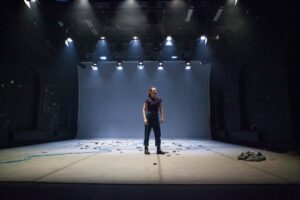
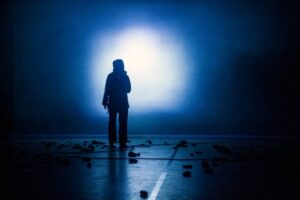
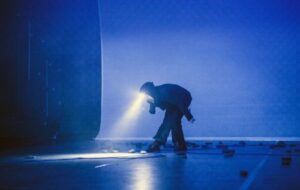
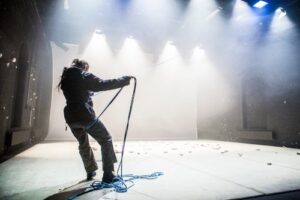
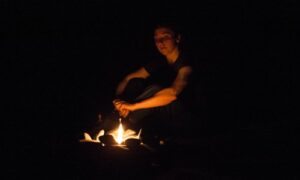
Into the Mountain (solo) was a studio performance commissioned by Tramway, Glasgow. It premiered as part of Dance International Glasgow in May 2017 (DIG 17), with a work-in-progress performance at The Baltic, for Gateshead International Festival (GIFT) in April 2017.
Created and performed by Simone Kenyon Lighting Designer Jenni Pystynen Sound Design Yas Clarke Movement outside eye Laura Dannequinn Producer Tanya Steinhauser
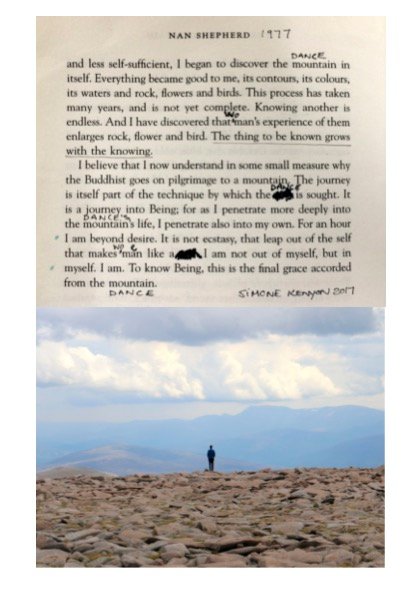
“ What more there is lies within the mountain. Something moves between it and me. Place and a mind may interpenetrate till the nature of both is altered. I cannot tell what this movement is except by recounting it.” Nan Shepherd, The Living Mountain.
Into The Mountain is a solo expedition that attempts an unearthing of movement from memory of being in the Cairngorms Mountains. Inspired by Nan Shepherd’s, The Living Mountain and her invitations to come to know a place through sensory and physical encounter; this new work forms part of an ongoing exploration into the relationship between walking, mountaineering and dancing.
Through the unfolding and transitory nature of both mountaineering and structured improvisation a place is brought about in which to explore what remains in one’s body through being both in place and out of it.
Simone Kenyon, Into the Mountain
Supported by Arts Council England, The Tramway, Stage@ Leeds, The Jerwood residency programme at Cove Park and Scottish Sculpture Workshop.
Many Thanks to Nick Anderson, Lucy Cash, Laura Bradshaw, Bodysurf Scotland, Dance Base, Neil Callaghan, Heather Forknell, Margaret Kerr, Frieda Morrison, Luke Pell, Murray Wason, Rosana Cade and Ivor Macaskill, the technical team at Tramway.
Simone Kenyon is an Associate Artist at Tramway.
Peer written responses to Into the Mountain (solo)
i) Dr. Margaret Kerr: Eco-psychologist and Artist
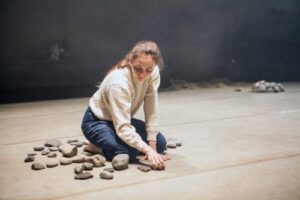
At the start I feel dissociated, disembodied. Things feel eerie. The sound echoes. An ever-present hum that comes and goes in intensity. Simone is skimming stones in all the directions. One by one. Each has the name of a place that I know, or half know. Images of the landscape come in and out of my mind, but what is ever-present, is the map. It never leaves me alone. Like a fly buzzing round my head, just out of view. I can see its colours, its contours, its flatness. I can feel its flatness.
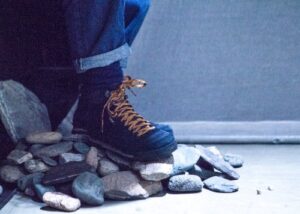
The stones give me comfort in this flatland. I know where they come from. I see the river. I can feel them in my body.
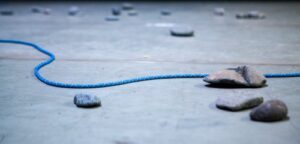
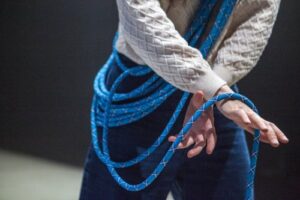
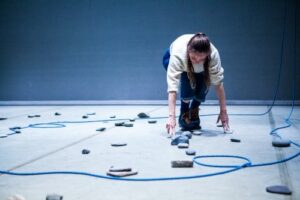
I can feel the river. Slowly, she pays out the blue ropes, weaving through the stones. Deliberately she picks her way through them and at the end announces definitely: “The River Dee.” I feel the full stop.
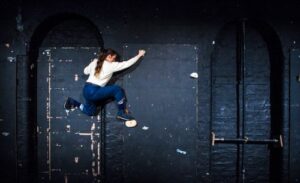
She starts traversing the wall. My body is following, like it always does when I watch a friend climb. She has set herself a hard route, I think. Each section is punctuated by a stop in a niche; each time she stops, facing outwards, sharing the relief. Like the madonnas in mountain shrines temporary sanctuary.
She makes it to the end of the traverse, a bit dishevelled. I remember the feeling after a hard climb, a bit more relaxed, more receptive, my ego shaken looser.
She makes her way across the stones, crossing a river, wobbling. I feel the memory of it in my spine and my belly.
The sounds are becoming more insistent.
The same sound is at once stones clicking together, a stonechat calling, pitons being hammered in, a shamanic drum.
She starts to rotate her upper body, I am connected back to Mila Koistinen’s performance. The same trancey feeling starts to spread through me I start to let go to this wild mysterious place and let it move into me.
Night is falling. She lights a fire. I am there by the river where we sat together next to the fire, went off exploring and came back. Sat among the stones.
It felt ordinary at the time, in the context of that vast still place, but now I can feel that it was not ordinary at all.
She wrestles into her bivvy bag, and my body remembers all the uncomfortable times it has done that.
trying to get comfortable. Trying to keep warm. The river is a constant presence now. It is dark and the night is still.
Gradually, very gradually, I start to hear the roar building. I imagine snuggling down in my bivvy bag, trying to pretend that the storm isn’t coming nearer. But it comes inexorably.
More wrestling. Head torch snaps on. How can a light be so eerie and so comforting? so alien and so familiar.
She is standing up bracing her body against the wind. It is getting harder and harder to move. The sound is building and building until it takes over my whole body. The sound and the whiteness, and through it all our breathing. It is all inescapable.
She walks with difficulty, trying to hold a steady line through it all, compass out in front,
But held solid.
I’m right in this now, in the whiteness, in the noise, in the white noise
in the stillness inside, in the breath, in the compass needle
Holding out against all this. I am afraid she won’t be able to keep going, that she will be scattered by it all and not be able to get back together. But she keeps going. I feel that keeping going so strongly in me… until she makes it to the rope, wraps it around. My body remembers the threading of the rope, the slow, painful descent. A classic abseil. Gradually the roaring subsides, she abseils back down through it, and I know she is safe.
ii) Luke Pell, Artist.
To Touch Time, a response to Simon Kenyon’s Into the Mountain
“time it’s self and the whole universe is travelling outwards, onwards […] we are always on the move, and beneath us the rocks travel too, a long migration to a land they do not know. A new world. I almost think I can feel them move. 1 ”
What is it to touch time? To hold, to fold, to move time, from one place in space to another. And in this touching of time to carry with you the weight of humans, their words, their walks, their weatherings and all of that which comes between. Rock by rock, stone by stone thrown, to land, to fall, to form some pattern pressed in air. We watch, we wait, it takes the time it takes, to move a mountain. To shift, to unsettle, to push on and through manmade modes of theatre to invite this other way of seeing. Sitting with, listening to, witnessing, what it is to sense and feel deeply, the passage of time as we become enveloped in layer upon layer of atmospheres intertwined and carried with care from there and that then, to here and this now.
Simone Kenyon’s Into the Mountain moves us from the macro to the micro, from the epic to the intimate, hovering bird-eyed above valleys we haven’t climbed – but, she has – to squat on rocks our palms have not met – but, hers have – to trickling, black iced water seeped between some surface, moist, carved out over years and year and years of motion, made present in thismoment – because she has – brought to us, in this time, that deep time slipperiness which spreads slowly, subtly, quietly, wholly, loudly, magnificently, through this space.
We are touched by time. Tuned to an attention, a careful consideration of the human and more than human landscapes of the Cairngorms mapped by Kenyon, poet and pioneer Nan Shepherd and those women who tread where and importantly, how, others don’t.
In Luce Irigaray’s The Forgetting of Air in Martin Heidegger, Irigaray continues her body of work questioning western constructs of our relationship to the four elements and to nature, thinking through the sexedness of being and bringing our attention to the materiality of that which is present in the space between. Air.
“The clearing of air is a clearing for appearing and disappearing, for presence and absence. At least how one can – one could? – think of it when forgetting the materiality of air. 2 ”
Irigaray proposes that in our relating to the world around us, what is most often overlooked is that which passes through us, gives us life, our breath, that which carries light, that meets our skin, that soft, opening, porous, permeable material of Air.
1 Maitlan, Sarah. There, Archieplago, Winter 2014. 48, 2 Irigaray, Luce. The Forgetting of Air in Martin Heidegger 1983. 17.
We might give more attention the value and significance of this seemingly invisible material in the open space alongside the certainty and solidity of object, buildings, towers, theatres, mountains, seen by men as things to have, hold and scale. Perhaps the space between things might be as important, if not more so, than the things themselves.
I wonder if it is the how of how Kenyon and the women she has walked with – in person and on page – that is at the heart of this work and what feels to me to be such a spacious and generous invitation, to take us on a journey into a series of landscapes we might never make ourselves.
Passing through places, days and nights and seasons, Kenyon – in an evening’s work – wears the weather for us and by sharing this journey, these journeys bring about a unique sense of perspectives and proportionality. Our place amongst the scale of things, living and not, what’s seemingly still, as they move in the world.
This is a journey made not to rise to a summit, to claim or to conquer. It is an opening of space, of self, of our perceptual plane. ‘The skin is a social organ3 ’ our surface meets with the surfaces of the world around us, we are pressed into air and all that is carried with it. These fine textures travelled through time, permeable, porous, precious, precarious. Kenyon uncompromisingly and delicately traverses these landscapes of living, offering herself as a portal into the places we might not ourselves dare to step.
“Because the body is itself a kind of place – not a solid object but a terrain through which things pass, and in which they sometimes settle and sediment. The body is a portable place wandering through the larger valleys and plains of the earth, open to the same currents, the same waters and winds that cascade across those wider spaces. It is hardly a closed and determinate entity, but rather a sensitive threshold through which the world experiences itself, a travelling doorway through which sundry aspects of the earth are always flowing. Sometimes the world’s textures move across this threshold unchanged. Sometimes they are transformed by the passage. And sometimes they reshape the doorway itself. 4 ”
3 McGlone, Francis. 2017. Fevered Sleep curated conversation on Touch at Wellcome, London , 4 Abrams, David. Becoming Animal.
iii) Dr. Sarah Hopfinger, Artist and Scholar.
Thinking back to the performance I have a sense of the process of you/your body in the landscape of the performance space – you in amongst rocks, climbing on the wall, pulling rope across the space, moving your arm back and forth, stepping on stones and balancing. I have a slow, slowing down feeling when I think about it. I also have some strong images burned into my mind like a specific position of you with your legs bent, hanging from the wall, you with your legs bound in the rope, you balancing on rocks with your weight all leaning on one arm…these are very specific images that feel both significant and insignificant in that they are not necessarily meaningful other than that they stood out and I felt connected to them in a very physical way. It feels so physical, my memories feel physical rather than what the work might have been ‘about’.
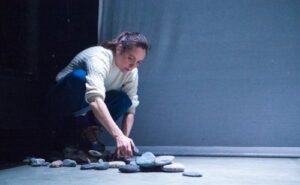
The opening section with the rocks – you trying to remember the names and say them right, sliding the rocks out and creating a landscape – has stayed with me. I went in and out of focusing on it – I was settling into the theatre space, being in an audience, seeing you…I was settling in to being part of this…the time you gave to this kind of setting-the-scene section felt important. As I watched this section I really SAW the rocks and had questions like: where are the rocks going to end up? Will they bump into each other? I had other questions too that were more about the meanings: Is this a real representation of a place? What does the actual place look like? Are these rocks from there? What do the rocks represent? Are they representative of the size of places? Why do you choose that rock for that name/place?
I think the question you put in your email about making work about a place/ecology is so interesting – there is the ecology and ecological material processes of the place/s you are referring to and then there is also the performance ecology happening now with you, audience, the materials in the piece – is there a question about what are the distinctions and interconnections between these two (or more) ecologies?
I have a response/question about the piece in terms of something I was unsure of – hope this is helpful. I felt like I wanted to see/connect with you at the start – like I felt so connected to the rocks and your naming of them, but almost not as connected to you the physical person in front of me (at this point). I became more connected to you when you did the climbing and when you moved swinging your arm back and forth and it was as if you were being taken over by the movement and I think you smiled, and I felt like ah there’s Simone. Perhaps before that I had asense that I was more connected to the material than you if that makes. Maybe this is interesting…how the human can get a bit lost when we focus on ecology/place?
I felt very comforted and happy about seeing a solo woman in these landscapes – I guess I can relate to that. It’s not something we see much in cultural representation of the outdoors – usually being in landscapes is a kind of sport thing or the landscapes are being very romanticised, and often if its someone alone it is a male. Somehow because you just focused on the materials you had in the space, you avoided romanticising the place and ‘nature’. I felt there was no judgment almost of the places you were referring to – you were just showing us something of the experience of being in the places. Being with places as opposed to being about places…
iiii) Neil Callaghan: Artist
Simone Kenyon’s Into the Mountain does what it says on the tin. It takes her experience of walking in the mountains and attempts to bring that experience into the studio theatre. In this translation from outside to inside a lot happens. When we look at a map we have to imagine the contours, the landscapes. We know that the map is not the territory and maps can only contain a limited amount of information. Like an alternative cartographer Kenyon gives us a map of the Cairngorms that does not necessarily impart a navigable geography of place, but it does give us something else, a sensual account of the place as experienced through her body, memory and imagination. It also differs to traditional maps in that this map exists through time. It is not possible to revisit the performative moments – they are fleeting. And although Kenyon’s sense of rhythm gives us time and space to absorb certain images once they are gone, they live within us a memory.
As well as viewing Kenyon’s performance as a map we might just as easily view it as an archive, an archive of place that exists within her body. The show begins with holding stones, rolling them into areas and naming significant landmarks. It is a conjuring up of geography. Thescattered stones bear little resemblance to an actual mountain range, but through this action she invites us to meet her with our imagination, to meet the language of the Cairngorms, its history evolved in language. Through naming she conjures the Cairngorms plateau but one that it is experienced through are imagination rather than scientific quantitative data.
Kenyon proceeds to place a blue rope through the space, both the apparatus for climbing such terrains that one would find in the Cairngorms and a signifier of the rivers that run through the area.
Kenyon climbs along the wall, traversing, climbing across indoor climbing holds and the radiators of the studio. This action reminds that we are not in the Cairngorms we are in a studio theatre. Kenyon does not want us to indulge in some escapist fantasy of transporting us to the Cairngorms, but rather wants us to reflect upon how an experience of the Cairngorms might usefully be presented in a theatre. Kenyon cannot bring the Cairngorms into the studio, but she can bring herself, complete with her memory and experience. She can give us images that invite us to go with her into the imagination. With the objects and surfaces of the theatre she invites us to see the space around her.
Changing perspectives, traversing from the wall to climbing across the stones Kenyon changes planes, she invites us to see her action from another perspective. It is a theatrical/choreographic effect, which produces a different gravity in the body, and therefore again offers a new way for us to see, to imagine. This new way of seeing and imagining is what Kenyon invites us to do throughout the piece and it is a spirit that chimes with Nan Shepherd. After traveling across the floor. Kenyon roots herself on the floor, the first time since she began traversing the wall. There is a sense of arrival. And then our attention shifts from Kenyon’s technical experience of her environment to she herself. Her body takes on a repetitive rocking movement, as if she is walking, but her feet never move. The focus is on the torso, the swing of the arms and where she places her eye contact. She speeds up, slows down, looks around her in awe, gets her head down and carries on. Through different muscle tonus and facial expressions, it appears that Kenyon is traveling without moving. We see her re-membering landscapes she has passed through, diverse terrains and different weathers. Whilst watching Iam reminded of walks I have taken landscapes I have passed through; the wonder, the humour, the delight, the hard work, the boredom, the joy.
As this section draws to a close the lights fade, and a fire is lit. A moment of silence. A moment of contemplation and reflection about what has taken place before. We are remembering the memory. There is quiet, there is calm.
Then there is the frustration of waterproofs, preparing to go outside for a pee when you just got into your sleeping bag, or getting up in the dark because you have to walk before it gets too hot, or the weather changes and interrupts your moment and you just have to get down off the tops. Fumbling about in the half-light to prepare yourself for the coming storm.
A haze machine fills the space with fog. Kenyon is covered in waterproofs. The clouds have crept in and Kenyon is battling with the rain. Moving around the space, in spasms and jerks, sometimes screams. It is at the same time both conjuring the memory of a storm and an expression of it. We see mist and a silhouette, but we hear an overwhelming sound that is a force in itself, and the experience of the effect rain, hail and thunder is tangible. It vibrates the room.
At the end of the storm we return to silence, our ears are different, after that experience they hear differently. We have been exposed to a different sense of scale. Throughout the performance sound operates to frame the action, to point towards the real, but also offer a theatrical scoring. It underlines the action. It oils our imagination.
Kenyon quietly gives her weight to the rope river. Abseiling back through the space into an exit Stage Right, almost slipping out of the space. The blue rope is pulled back through the pulley and across the stage. The last image a blue rope disappearing stage right, and it leaves us with the question – what traces have we left in the landscape? And what traces has the landscape left on us? For us we are left with the imprint of this performance, memories triggered, desires activated, curiosity aroused. We have been taken Into the mountain and we return to the world, with a different way to inhabit the world.
Photos by Hev Forknell
We use cookies to ensure that we give you the best experience on our website. If you continue to use this site we will assume that you consent to the use of cookies.Accept